80days left
Guangzhou Unveils 15th Five-Year Plan: Anchoring a World-Class Biomedical Cluster and Building a Higher-Level Healthy Guangzhou
Author:广州医博会
Time:2026-05-29
Reader:14
On May 29, the "Outline of the 15th Five-Year Plan for National Economic and Social Development of Guangzhou Municipality" (hereinafter referred to as the "Plan Outline") was officially released.
Spanning nearly 100,000 words and comprising 33 chapters, the Plan Outline sets forth Guangzhou's development goals for the next five years. By 2030, the city aims to make significant strides in building a modern people's city that is innovative, livable, beautiful, resilient, civilized, and smart. Guangzhou strives to elevate its economic strength, scientific and technological prowess, comprehensive urban competitiveness, and international influence to new heights. The per capita GDP is targeted to reach the level of moderately developed countries, taking the lead in basically achieving socialist modernization. Looking ahead to 2035, the primary objectives of "Reinventing a New Guangzhou" are set to be fully realized, with the total economic volume projected to double compared to 2023, striving to achieve decisive progress in socialist modernization.
The excerpts related to healthcare and the biomedical sector are as follows:
Chapter 3: Strengthening Guangzhou as a National Base for Advanced Manufacturing
We will deeply advance new industrialization and implement the "Breakthrough Project" for key industrial chains. The goal is to promote the qualitative improvement and quantitative expansion of strategic industrial clusters, accelerate the movement of advantageous industries toward the medium-to-high end of the global value chain, and form an advanced manufacturing cluster characterized by trillion-yuan leading industries, hundred-billion-yuan supporting industries, and ten-billion-yuan emerging followers, thereby reshaping the new advantages of "Made in Guangzhou."
Section 2: Actively Building the "Growth Engine" for Emerging Industries
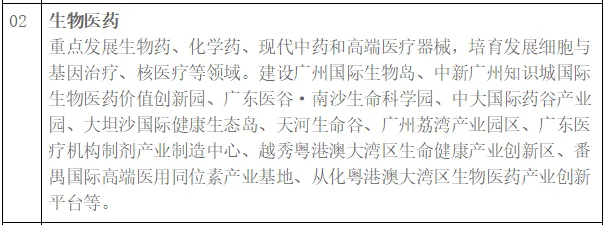
Build a world-class innovative biomedical industry cluster. Focus on achieving breakthroughs in innovative drugs and medical devices, and drive the development of the broader health industry through the biomedical sector. Vigorously develop biological drugs, chemical drugs, and modern traditional Chinese medicine (TCM), and advance the construction of production bases for a batch of pharmaceutical products, including antibody drugs and innovative anti-tumor drugs. Provide full-chain support for the development of innovative drugs by improving the policy support system covering R&D, review and approval, industrialization, hospital adoption, and diversified payment mechanisms.Expand and strengthen the high-end medical device industry, focusing on the development of in vitro diagnostic instruments, cardiovascular and cerebrovascular diagnostic and therapeutic devices, imaging diagnostic equipment, and orthopedic and orthodontic devices. Leveraging platforms such as the Greater Bay Area High-Performance Medical Device Innovation Center and the Guangzhou Medical Device Testing Center, we will promote innovation in fields like medical robotics, high-end medical imaging equipment, and AI-powered medical devices. Cultivate and expand future industries such as cell and gene therapy (CGT). Utilize Nansha's pilot policies for CGT to layout and build regional cell preparation centers, attracting a cluster of CGT enterprises. Proactively plan the nuclear medicine industry, focusing on key links such as the preparation and supply of medical isotopes, R&D and production of novel radiopharmaceuticals, and the manufacturing of high-end diagnostic and therapeutic equipment. We aim to foster and introduce a group of leading and specialized enterprises, expand a number of nuclear medicine institutions with national influence, and elevate the technical level of nuclear medicine diagnosis and treatment. Promote the coordinated development of large AI models and biomedical technologies, accelerate the construction of projects like the National AI Pilot Base for Healthcare, the China Digital Lung at Guangzhou Laboratory, and the Greater Bay Area Biological Information Center, creating a highland for the integrated development of "AI + Biomedicine."
Propel the AI industry into the national top tier. Widely implement the "AI+" initiative, promoting the deep integration of AI with various sectors of the economy and society. Strive to become a testing ground for outcome transformation, a demonstration zone for industrial application, and a bridgehead for international cooperation under the national AI development strategy. Focusing on key application areas such as industrial manufacturing, comprehensive transportation, pharmaceuticals and health, energy and environmental protection, modern services, and urban governance, we will vigorously develop multi-modal large models, vertical large models, and AI agents. We aim to cultivate a batch of "AI + Industry" solution providers and intelligent agent application service providers, building a "Capital of Vertical Models." Strengthen the R&D and production layout of intelligent terminal products such as smart wearables, smart home devices, health and medical equipment, and service robots, turning "AI + Robotics" into a high-tech, high-growth, and large-scale industrial cluster. Accelerate the construction of the National AI Application Pilot Base, and around fields like healthcare and energy, build common technology platforms for industry applications to provide services such as technical verification, scenario testing, product incubation, and application promotion. Encourage leading enterprises, universities, research institutes, and new R&D institutions to collaborate in creating AI innovation platforms, tackling core technologies such as core algorithms, operating systems, and high-end chips. Support the Pazhou Algorithm Competition in becoming the "World Cup" of algorithms, expanding the international influence of AI algorithm contests. Layout immersive AI application scenarios based on real-world settings, providing a real interactive co-creation space for "first trials, first applications, first demonstrations, and first experiences" for technological innovation. Regularly release opportunity lists for application scenarios in key areas. Through offline "AI+" application supply-demand matchmaking events and an online AI industry service platform, we will accelerate precise supply-demand matching, actively promote the对接 of local scenario opportunities with global application innovations and product R&D, and build a globally leading open cooperation zone for AI scenario innovation.
Chapter 29: Promoting High-Quality Population Development
We will actively adapt to the new normal of population development, accelerate the construction of a population service system that covers the entire population and all stages of the life cycle, provide education that satisfies the people, and build a "Healthy Guangzhou" of a higher standard, effectively supporting the comprehensive improvement of population quality and the continuous optimization of population structure.
Section 3: Building an Efficient and High-Quality Healthcare Highland
Elevate the status of a medical center. Consolidate and enhance the medical functions of a national central city, build a high-level hospital system led by top-tier institutions and supported by the top 100 hospitals, and upgrade Guangzhou's medical services from "regional leadership" to "global reach." Enhance the radiating and driving functions of national medical centers, and actively strive to establish national medical centers in key fields. Actively seek the layout and construction of major platforms such as national key laboratories, strengthen the integrated functions of clinical diagnosis and treatment, scientific research translation, and talent cultivation in high-level hospitals, and accelerate the construction of research-oriented hospitals. Implement the "Clinical Specialty Navigation Plan," consolidate and enhance advantages in specialties such as respiratory medicine, oncology, ophthalmology, and pediatrics, cultivate and expand strong specialties like nephrology, hematology, and psychiatry, and shape internationally first-class specialty brands. Layout and build clinical medical research institutes and diagnosis and treatment centers for major difficult and rare diseases, creating internationally influential centers for the diagnosis and treatment of critical and complex illnesses. Explore the provision of international medical services and cultivate influential international medical service brands. Deepen institutional opening-up in the medical field, promote the integrated development of healthcare, insurance, and tourism, and build a medical service system aligned with international standards. Collaborate with high-quality medical resources from Hong Kong and Macao, accelerate the clinical application and translation of internationally advanced drugs and medical devices, and improve the coordination mechanism for regional medical resources and the sharing of outcome translation.
Build a diversified and complementary pattern of medical service supply. Deepen the reform of public hospitals guided by public interest, covering staffing, compensation, medical service pricing mechanisms, and comprehensive supervision. Establish a pricing mechanism led by medical services, improve the centralized volume-based procurement and supply guarantee system for drugs and consumables, and promote the coordinated development and governance of healthcare, health insurance, and pharmaceuticals. Strengthen the construction of a tiered diagnosis and treatment system, using close-knit urban medical groups as a carrier to improve continuous and integrated service levels. Guide and regulate the development of private medical institutions, and support the development of wholly foreign-owned medical institutions. Implement a digital and intelligent offensive in health, promote the application of AI in the healthcare field, and build an integrated health service platform that covers the entire population, spans the whole city, and is shared and convenient.
Consolidate grassroots medical and health services. Implement the foundation-strengthening project for healthcare, promote the extension and sinking of high-quality medical resources, and ensure a balanced regional layout. Optimize the functional layout of grassroots medical and health institutions, and comprehensively build a "15-minute health service circle." Advance the construction of the provincial comprehensive pilot zone for high-quality development of grassroots health, deepen the "close-knit integrated management of town and village health services," and achieve full coverage of village health stations. Support eligible community health service centers and town health centers to add beds for rehabilitation nursing and palliative care. Guide physicians from medical institutions at the secondary level and above (including retired clinical physicians) to participate in family doctor contract services.
Improve the public health system for mega-cities. Continuously optimize the disease control system, advance the capacity building of provincial regional public health centers and grassroots disease control institutions, and elevate regional public health levels. Build a unified and highly efficient major emergency command system, accelerate the construction of the municipal emergency medical rescue command center, strengthen the standardized construction and management of health emergency teams, enhance practical combat capabilities, promote the development of the aviation medical rescue system, and improve capabilities in infectious disease prevention and control, emergency medical rescue, blood supply guarantee, and comprehensive emergency response. Strengthen occupational health protection, improve mental health and psychiatric services, and enhance the service quality of the 12356 psychological assistance hotline. Strengthen comprehensive prevention and control of chronic diseases, develop a full-chain service of prevention, treatment, rehabilitation, and management, improve the early screening, diagnosis, and treatment system, and keep the premature mortality rate from major chronic diseases below 9%. Promote the construction of national comprehensive pilot demonstration zones for chronic disease prevention and control.
Build an innovation highland for traditional Chinese medicine (TCM). Led by national TCM medical centers, promote the construction of demonstration projects for the inheritance and innovative development of TCM, and facilitate the expansion and balanced layout of high-quality TCM medical resources. Deeply implement the Lingnan medicine inheritance and national medical master cultivation project, strengthen the construction of integrated Chinese and Western medicine talent teams, and build high-level key TCM disciplines. Implement the TCM health promotion action, advance the upgrade of the "preventive treatment of disease" health project, strengthen the capability of specialized rehabilitation services, and build integrated Chinese and Western medicine rehabilitation wards. Enhance the scientific research and innovation capability of TCM, implement the "Famous Prescriptions and Formulas Project," accelerate the R&D and clinical application of TCM preparations in medical institutions, implement the action plan to upgrade standards for Lingnan TCM and in-hospital preparations, carry out innovative research on TCM quality evaluation methods, and promote the translation of TCM preparations into new drugs. Elevate the international influence of Lingnan TCM, promote the integrated development of TCM with elderly care, culture, and tourism, and cultivate new TCM business formats.
Key points of the Planning Outline explained in one diagram:

Scan the QR code to view the original text:

Source | Guangzhou Municipal People's Government Portal Website, Guangzhou Daily
Prev Bay Area Connects Globally, Innovation Drives Health | 2026 Guangzhou Medical Expo Invites You to Attend This Grand Event
Next Quick Update: Pre-registration for visitors to the 2026 Guangzhou Medical Expo has officially commenced.
相关推荐
- Bay Area Connects Globally, Innovation Drives Health | 2026 Guangzhou Medical Expo Invites You to Attend This Grand Event 2026-05-22
- 2026 Guangzhou Medical Expo Scheduled for August! Building the Core Engine for the Greater Bay Area's Healthcare Industry. 2025-11-07
- Full-chain Empowers Industrial Innovation! The 2025 Guangzhou Medical Expo Successfully Concludes Today 2025-08-24
- Grand Opening of 2025 Guangzhou Medical and Health Industry Expo: Jointly Paint a New Blueprint for Health and Play the March of Industrial Endeavor 2025-08-22
-
Exhibition Overview
Exhibition IntroductionOrganizationExhibition RangeExhibition Promotion -
Media Center
Exhibition DynamicsIndustry NewsExhibition PhotoExhibition VideoPartner -
Audience Center
Visit ScheduleVip Registration -
Exhibitor Center
Why To ExhibitScheduleExhibition Floor PlainBooth ReservationDownload Center -
Concurrent Activities
Forum activitiesRoadshowCompany Promotion -
Business Travel Service
City IntroductionExhibition HallSightseeingHotel ReservationTraffic Guide -
Contact Us
About UsContact Us
Copyright Guangdong Silver Age Health Industry Co. Ltd.
粤ICP备2021159608号-6
 粤公网安备44010502003694号
TEL:+86 020-38109036 E-mail:eld@eldexpo.com Add:Room 3205-3207, Block E, Poly World Trade Center, 1022 Xingang East Road, Haizhu District, Guangzhou City.